TMIT 48: Can We Prevent a Midlife Crisis?
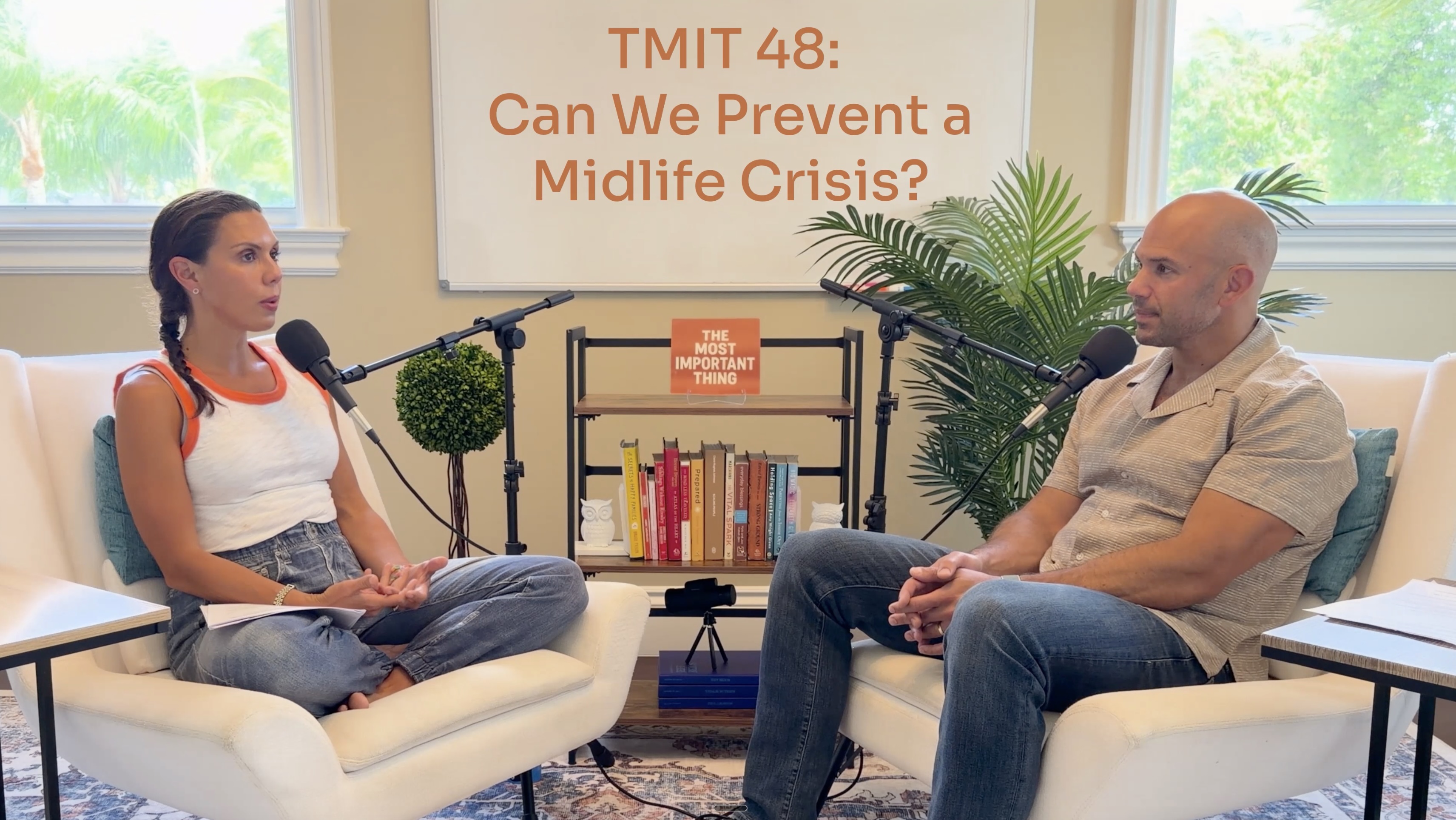


We spend our twenties and thirties knocking down goals like bowling pins. We secure the career, buy the house, and start a family. Checking all those boxes triggers a strange realization. We look up and see the path forward is completely undefined.
Coming home from our recent spring break trip to Sedona forced a total reset. The air shifted. We realized we have officially entered a new phase of life. Danielle is turning forty next month and standing at a crossroads. She is looking at the chasm between the constant pursuit of goals and the actual meaning behind them.
We dive straight into the data behind the midlife crisis in Episode 48. Research shows human happiness follows a U curve that hits rock bottom around age 47. People find themselves managing aging parents and raising kids while experiencing massive hormonal shifts. The midlife crisis is ultimately a crisis of meaning.
We get vulnerable about the new dynamics in our own home. Greg shares a massive shift in his mindset. Home used to be the place where he collapsed to recharge for work battles. He is flipping the script completely to invest his absolute best energy directly into our family culture.
One of the most intense parts of this episode is our premortem exercise. We sat down and asked what the wreckage looks like if we stay on autopilot for the next ten years. We are sharing our failure map so you can start drawing your own success route.
0:00 I am having such a hard time staying in reality right now. I'm swept up in the summer house drama and I'm just listening to Actin Tough on repeat. OK. I think it's the cortogen. That peptide tends to have me dissociate a little bit. I think also part of it is having the foster puppies. It's like there's so much going on that my brain wants to jump ship. Sure. Do you understand? Yeah. As like a way to manage the the stress. I I totally get that. Yeah, I totally get that. I mean, could also be that you're turning 40 in a couple. Of weeks, yeah, we can get into that. It. Could be. The question how does that feel?
0:44 I think is a really lazy question for people to ask, but everyone asks it. Yeah. So you have to have a response like be prepared, but also no, that that's not the question I care about. Right. Yeah, no, but my answer is like, really good. I think I told you the other day that I was reflecting on some of the things that I can do at 40 that I couldn't do at 30, right? Like handstand or 360 breathing. I'll have to look at my list. There's a couple of other things, but 40 feels really good. And I was actually talking to my dad the other day. We had a surprise 40th birthday party for him. And so, yes. And so I was probably like, 11.
1:26 It was a great party. First of all, he was very surprised. But I just remember that as, like, being good times. I must want to call it like, fertile times, if you will, like prosperous times. And he said, yeah, he's like, it's not until 50 that the wheels start to fall off and things start to hurt. Like 40s is actually good. And I can see that because I think that I've gained a decent amount of wisdom. I'm sure there's plenty more to be had, but I do feel a bit more sure of myself. And yet, as we've talked about, I feel like stronger than ever. I'm definitely have like much better lifestyle habits than I did when I was 30, right? So all systems are online, right?
2:07 And I think that's here in line is the conundrum, which is like all systems are online. What do I do? Because I have checked off everything on the list. I've got the man beyond my wildest dreams. I've got the kids more than I even bargained for, right? Like, this is amazing. These are great. So wonderful husband, 3 kids. I in many ways checked that career box when I turned 30, right? Because I had the job, I had the title, I had the salary, I had the mandate. And so I haven't really felt like I need to come back around to that. And so as the consummate achiever that I am, it's a little tricky right now. So I'm like, OK, what am I supposed to do? Because I still have, at least according to my dad, right, at least a decade where I'm going to feel really good. And I don't really know what to do other than to, of course, lean in to what I already have.
3:11 But there's no new item on the list. And that feels pretty weird because we are great at running down goals, right? Line them, line them up, knock them down like bowling. That's right. And I don't necessarily have one to line up yet right now, and I don't know if that I will. Yeah, it's it's, it's the same conclusion and you came about it in a totally different way than I did. But I think we've both reached a very similar point and that's why I proposed that we have this conversation to look into preemptively.
3:54 Preemptively I got. To taking a page out of my book. Very preemptively. By being preemptive, yeah. To look into why people have midlife crises, what is that all about, right? And we can talk about where this, I started to notice a shift recently and, and what that was about. But as we explored midlife crises, I think, and maybe this is just the research kind of leading us down a path that we already wanted to go down. But it's basically saying like midlife crises are not about failure. It's about checking all the boxes and then not knowing what's next, right?
4:36 I don't know is. It though, well, it seems like it's a meaning crisis. A meaning crisis. I don't based on what I understand and just what I have like perceived, right? This is this is a Bravo podcast sometimes. And so when I think about like Mauricio Umansky being married to Kyle Richards for over 20 years, almost 30 years, and then the being separated, he has definitely gone through a midlife crisis of sorts with partying and women, right? And so I think that that's a common trope that we see, particularly for men is like the fast cars, the stepping out, the partying.
5:17 And that I think Kyle has even said Harkins back to the fact that he got married so young and she already had a kid and they started having more kids. And so he didn't he didn't check that box, right? And now he's able to do it with the wealth that he's accumulated. And so I just wanted to kind of give my retort to that because I do think that sure, you can have a crisis of meaning, like I'm having a little bit, which is like, OK, what else is there? But it's also a time I've heard it called like a midlife audit as opposed to necessarily a crisis. It's like, OK, what boxes didn't I check? Right. How do you build a life that you don't want to run away from? Is what this is all it all?
6:02 It all comes to a head with that with that question. Maybe. I mean, I don't want to run away from my life. No, I know. And maybe, you know, maybe I'm not in the midlife crisis part yet, but I do tend to do things early, so maybe I am. I don't want to run away from this life at all. I have just been on a bit of AI, don't want to say hamster wheel, let's call it like mountain trek, right of pursuit for 40 years. And now I just don't know. I don't see the next mountain top. OK, well, let's dig into a bit of the the meat on why people have midlife crises. And then let's circle back to where you and I stand and how we can nip this in the bud or things that we can do to proactively get ahead of anything that that would look like a midlife crisis.
6:59 So let's let's talk. About. Let's talk about why the Why midlife crisis happens at a certain time. Like all all of these reasons, all this confluence of events is happening all at once. So to break them down into the most, the least obvious, most obvious is half your life is over. You start doing the math. Right, right, right. OK, next is this idea of life in general takes AU shape in terms of happiness where 47 like is the low point of of happiness in life. So why is that right?
7:47 Well, it comes down to like the situation. So lots of people are taking care of their young kids and maybe even trying to get their kids into college around that time while taking care of their aging parents. Called like the sandwich. Right. And on top of that, there's just a total blast of hormones and hormonal shifts that happened. Yeah, unfortunately not that many hormones. It's like hormones are hormones are plummeting in in women and in men. Right. And so that's a it's a natural time to feel like crap about your choices and to look at all that's going on in your life and be like, what did I do?
8:34 And realize now here's the the biggest thing I think is that it forces you not just to think about how many years you have left, but about how narrow your choices of what you can do with those years are, right? So you can't you're not going to be a congressman or congresswoman, right, right. You're not going to go play Major League Baseball. You know, you know, you're, you're, you're kind of limited. Might not even. You might have had a dream of being like Aceo of a Fortune 500 company and realize shit, that's not going to happen. Yeah, as you're saying this, I'm actually thinking about, you know, kind of that U shape that you've that you've said and and kind of what I'm experiencing as well, which is I think that if the first half of your life is all about pursuit and the second-half of your life is all about meaning, then I think that this is the time where we have to cross the chasm and shift from pursuit to meaning.
9:31 And I would imagine that that's easier for some than others, but it's probably not easy for anyone. I think it's different for everybody in terms of what that means, right? Because everyone's percentage of the pie in terms of what they want to do with that time is going to look different probably based on what boxes you've checked already, right? So we we move out of this like ambition box, checking into this like satisfaction, this trying to solve for life satisfaction versus, you know, trying to solve for as many things that we could do and finding that answer to satisfaction is extremely, you know, you're it's so idiosyncratic. Can you talk to us a little bit about how you came upon this idea and what's been happening for you more recently? Yeah, sure.
10:16 So over spring break, we had a great time. I'm not going to say like it was the best spring break ever. It was really, it was solid. We went to Sedona and Flagstaff. The kids just love being somewhere different. They love being in a different house, they love being in a different car, they love being in a different state. So do I. Same, right? It's very bonding to just spend time together, being together and also being alone together, right? Like like 2 hours in the car, a lot of like being alone together. Yes, right. Without our typical work obviously, but also just house tours. Yes, exactly.
11:01 And there's something really special about having that space that creates these peak moments, I would say that are 10100 times. This is like power, law and venture capital, better than what we have at home. Like I'm not saying that the day in day out is 100 times better. I'm saying that like 1 moment on the trip when we're driving through the hills singing Do Re MI from the Sound of Music together as we are practicing. True story, he's talking about an actual peak from. The trip we're working on our, our, our vocals in the home working. And there was just something so connecting about being on the same wavelength in the same, in a different place in a beautiful environment. Just like looking out over the hills in a, in, in a situation that was a little bit risky, like not really, but just like driving the switchbacks in, in, in a, on a big mountain, a little treacherous, like just so special. And I think at least for me and you and I think for the kids too, like that was that was a peak. And that peak stayed with me through the, you know, the plane ride home.
12:15 I'm like reflecting on the trip and I'm sitting on the plane. Can I just? Say, circling back to our Family Adventures episode, the peak end rule, Danny Kahneman's peak end rule, that's what you're experiencing. For sure, but my reflection was that you can't manufacture things like that. You have to have days of connectedness in order to get to that peak. It doesn't just come about because we all drop things and say, hey, let's skip school today and let's go on. Like, you know, let's get in the car and go somewhere like that could lead to some fun stuff. But spring break, 9 days together, no work, just family. That's what I'm talking about. And so I'm on the plane home and I'm thinking to myself like, what are some of the things that I can do not to shift 180, but just to calibrate a couple of degrees so that I have more time enjoying family time. Like, there's a little bit more ambition in me to channel that into family life and to show up a little bit more versus just bringing what I have leftover at the end of the day from work home.
13:26 Right. And I wrote down a couple of things. And, like, I've just started to implement little, little things like checking my e-mail twice a day instead of, like, on my phone every time I pick up my phone hit. You know, that's a good one. Yeah. Where I've been amazed with the results, not just for the presence that I have with the kids, but for how much they engage with me. And I'm noticing this. And I'm like, wow, a little goes such a long way. And it really helped that it was after spring break that we were kind of like, it was a good way to buffer the dopamine to like still connect with family and not just like go back to our normal routines.
14:08 And so I found that what I, what I was really journaling about on a plane was like, how to avoid having this midlife crisis, this moment of what's it all for? Why am I putting so much into work if at the end of the day, I'm coming home and I don't have anything left to give to my family or I'm so anxious about, you know, XYZ thing that I'm ambitious where my ambition and my energy go into work that that's just not that it's an afterthought when it comes to family and putting any ambition or, you know, drive into even just like connecting a little bit more so that we can have more peak moments.
14:59 And yeah, that's where I came to you. And I said, I think there's a an episode here. I think there's a conversation to be had. And I think that a lot of people that are type A and highly ambitious. A good analogy that that I that I heard is get to the end of like 100 hour video game in like a role-playing game where you've collected all the armor you've got, you've beaten all the levels, you have nothing left to do. You can wander around the land, but it's like, now what? Right, right. And so if I can, what I think you're saying, and certainly this is what I'm feeling, is that we see the midlife crisis kind of looming in the distant, currently distant future, but things are starting to, things are starting to shift for us a bit. And then it seemed like, you know, I'm noticing a lack of that next mountaintop and like things to pursue. And you're noticing your energy shift from, or at least an opportunity for your energy to shift from achieving and orienting yourself towards work and your career to actually perhaps setting goals or intentions within the family. Sure, or or.
16:19 Even just simply family hard and put some of that energy into work instead of work hard and put some of that energy into family. I'm not saying I'm going to work any less hard, but I am going to be more intentional with what I'm doing during the day. Just like it's a, it's a work audit. I'm like, where am I being effective? Where is are it? It's almost like preparing myself for a little bit of AI, Greg, like who's the agent that can operate in the background and do things, and who's the guy that has to actually do things where an agent cannot? And I think that's the split.
16:59 Is there space? For us to do like a pre mortem here. Oh yeah, right. Absolutely. A pre mortem, you know, it's kind of hard to do a pre mortem 10 years from now, but even five years from now, if this family, if this marriage, if this individual journey were to fail, why would it fail? That's what I would like to talk about a bit. Sure. Well, at a high level, the first thing that comes to me is we let the family system collapse and break down into individualism. Yeah, say more where?
17:44 I'm pulled into coaching a sports team, and I'm not seeing you on a Saturday, and you're pulled into bringing someone to swimming and you're not seeing me on a Tuesday. And, you know, dinner is just haphazard. Like, everyone just kind of like, eats what they eat and grabs food from the fridge and goes to their room and does their homework. And then, you know, I'm in the office working, and I get angry when people are making noise. You're downstairs, You don't know what's going on with work. We record a podcast. We try to talk about, you know, how we're staying connected. But in reality, things are just breaking at the seams. And it's because everyone has their own little life and family is no longer a team that we are putting first. Yeah, that would definitely break us up for sure. Break up this family.
18:35 I think my, the first thing that comes to mind to me is, is this is like a really fear based one, which is I worry that if we focus too much of, on our, on our family. And I have to say like this is what comes up for me a bit when you start talking like this, just being really honest here is that we'll over index on family and we will lose what we have professionally and in our career and then we will live in a cardboard box in our 50s. Yeah. That's a big one just to be. Very extreme. Because. You know, we really did not that we haven't worked hard in our 30s, but we really did give our whole selves to work in our 20s. And that created a financial base to move to Florida when things got tough in New York and and buy this house and really jump start, you know, have three kids without worrying financially, right?
19:28 And now we are reaping the rewards of that. We have been for the past decade. And so a lot of me says, OK, now it's time to turn our pendulum, to swing the pendulum and our intentions, our focus back to career. But it's going to look. So even if we were to do that, it's going to look so different now because you didn't you and I didn't even know each other for most of our 20s, right? So it was me working over here, saving, toiling, saving toiling, crushing it. Toiling is not the right word. Saving crushing it. Saving crushing it. And you doing the same, right, building your business. And now there's a lot of us on the trail, right? And so that's another that's just a fear that I have that I don't want to be this kind of like dark cloud, but I do want to kind of allow it to.
20:19 I want to pull it out of the shadow and bring it into the light and figure out how we can be level headed and rational about that idea. Yeah, I see you. I have the same fear. It's not founded, but it is hysterical, historical, and so I'm programmed to do everything I can to make sure that that doesn't happen. Because that is what happened in your family of origin. Something like it. I don't know if it was because of too much focus on the family and I don't think that that's what we're at risk of either, but just extrapolating out the piece that creates cardboard box is business failing.
21:08 That's definitely something that I am. I do not take, I do not take lightly like I don't take my eye off the ball because of that. And when I talk about family, actually in my plain journal, I said work hard for family. That is the driver of work, family hard with every second that we don't have to work. And that's truly what I mean. I think that even what we're doing here is family and hard. Yeah, and well setting. Setting aside time to be intentional. Exactly working.
21:49 Hard for family is such a shift in you, though. It's such a shift. It's it's. Such a shift, well, the the shift of working hard for family. That is, believe it or not, a shift away from working hard out of imposter syndrome. Mic drop. That's the. Shift is wow. OK, I. Know that I belong at work now. Wow, so it's like coming from a place of confidence and competence at work, not. Overconfidence, just knowing that I didn't say overconfidence, no, but just it's not overconfidence, it's just knowing that that knowing that I just said coming from.
22:37 A place of confidence, you read Overconfidence. No, I didn't. Read Overconfidence. I wanted to name that for myself, OK, Because I don't want humility. Yeah, it's, it's coming from a place of believing in myself. OK. Versus. Believing that if I don't do everything for work, I'm going to fail. That's the difference. OK, what created that shift? The peak moments of the family, it's not that seeing the product on both sides at work and at home and when we focus on the process on each how things happen that created the shift is realizing that it's the same thing.
23:24 And so not giving enough at home isn't going to lead to the same amount of self-confidence and self belief that I can then channel back into work. So like going to bed every night, grateful for a peak moment of the day that I had with usually one of my kids. We have lots of peak moments, you and me. I don't know. I've been noticing the ones with our with my kids because I don't, I'm not. Jealous. But noticing those makes me want to reinforce the rules around doing work at the most efficient way and the most effective way, instead of filling my day with work to make it feel like I'm I'm working that hard, sure. And coming from a place of imposter, less than like I have to do this or else.
24:13 Yeah, got it. OK, well, that's great. Congratulations. That's that feels like a real really big milestone, yeah. It is it comes with a lot of other prescriptive advice that I'm giving myself to. It's not just like, you know, be a more present dad, like that's part of it, I would say, but it's like I, I wrote, make family part of the work thought explicit experimentation and curiosity in order to achieve these peak moments that nothing else can recreate. So it's like working smarter in order to have the present mind to disconnect from work and go and be in the world together or just be at bedtime together and not be on my phone. It's not like I don't feel, I don't feel like it's the phone's problem or a problem that I have with the phone or the work. It's about noticing what's actually productive versus what just feels like anxiety.
25:38 Yeah, I have written. Down here, good at achieving does not mean good at living, says. Who? Whatever the the back nine of life looks like in terms of getting satisfaction and how you feel that time with that pie. It seems to me like the common threads here are to stretch your capabilities, right? So try learning things that are outside your comfort zone 1 and that can still apply to your life. You don't have to like go and you know, learn, you know, get your scuba license or something like that. But but you could too. And if that is in pursuit of useless joys, like useless joys are a godsend to extending the brain's life, to extending our lives and the usefulness of the brain. So looking for those things that stretch us as people, like maybe it's mindfulness, spirituality, a new hobby, a new sport, You know, more time with your daughter right in the morning on the math homework, like whatever it is like. And something that's just for you, that's really just for your brain, that helps your brain stay young. Yeah.
26:50 And I think so much of that advice that was geared towards like empty nesters, like true 55 plus senior living, right? And so for us, I think because we are seeing these things start to percolate, it is really finding those micro moments like for sure my puzzles or dry brushing or whatever it is for you that are these, what did you call them like purposeless joins or something? Useless. Joys. That is key. Next decade in my 50s, I really hope to be taking art classes at the Cornell Art Museum. But that's just not really on the table right now, right? And so I'm still like, for me, jury's still out about what my 40s bring.
27:35 And I hope that there's a lot of health and longevity and positive things, right? And that, you know, that we can, whatever bumps in the road may come, that I will be able to be lifted up by those. And. Honestly, being an entrepreneur that's trying to now build 2 businesses, I don't have the I can think of ways to extend, for example, socially, I can think of ways, especially spending time with younger people, I think is a good, a good version of this like like stretching your mind and and staying young. But I'm not ready to turn on that social burner yet. I don't think that I can for some time.
28:15 Our house. In Vanderpump. Exactly. Exactly. So, so you will notice that one of the things I wrote down in my plane journal was watch Bravo with my wife. Because if we do the masculine together, if we do the business building together, if we do the family raising together, we have to do the gossip and feminine together too. That's right. And I'd rather gossip about reality TV stars than real people in our lives, yeah. And just it's not congruent with our bedtimes to do anything other than watch. That's true television at our at our own pace, you know, But I do think that this is a good conversation because it's about awareness. It's about being aware of like where we are, what might come and get us, how to nip in the bud this idea of feeling empty or feeling like we have nothing less to left to achieve.
29:07 And that being the modus operandi that like that is, is the only thing that matters to us. So I don't know where this takes us on a long term horizon, but I do know that I've made a couple of small, like maybe one to two degree shifts that really do feel like it's giving me purpose and is giving me time to to, you know, spend a little bit more with people that I love. And if I can keep doing that, like hopefully I can put off some of these midlife crises issues for for another 5-10 years forever.
29:49 It's funny, I think that whether we talk about the conversations that we wish we would have had when I was pregnant or adolescent Academy or now heading into midlife, what I'm hearing is the same thing, which is naming our notices, right? And just building the habit of having these small kind of micro conversations, talking about where we each are, right, and what we're afraid of and where things could go wrong and just really making the implicit, explicit right until the next conversation. But what I see now and what I'm grateful for and for you really kind of staking the claim in the ground is that we're, we are going to talk about this stuff.
30:33 And as we start to notice things shifting in us, we are going to start making tweaks. But we're not going to make tweaks in isolation and not tell anyone about it, right? We're going to talk about what's coming up for me, what I'm noticing, what I'm scared of and why I'm experimenting with this week so that we can recognize that we are in we're on a team and that there are knock on effects of those. And I'm just grateful that you're talking about, you know, getting up half hour earlier instead of I'm going to go buy a Lamborghini and not talk to you about it, right? So 'cause I, I really do think that like, you know, if we avoid these conversations or we just don't make time for them, 5710 years from now, there's going to be like a Robin's egg blue Lamborghini in my driveway and I'm going to be like, where did this come from? Right?
31:24 I I would. Wonder where that came from, too, because to be clear, the research says that the Lamborghini, the affair, these are things that are reclaiming things that about you that you've lost. And I do not feel like I've lost anything in being a part of this family. Well, that's great. Let's let's make sure that it stays that way. Yeah, right. And so for me, it's a really good sign that you felt strongly enough about these notices to to talk about it totally. And every, you know, 3-6 months, stick me in a new state, new location with the cyber truck, drive around with this family and that's all I need.
32:06 Yeah, I love that. I mean, all of you probably know much better than we do. We did not travel for five years after COVID, right For the. Most part other than work travel other than. Work, travel, right? Certainly not traveling as a family. And now we have the adventure itch, and not just because of the adventure, but because of the reset that we get when we come back. Yeah. And the. Opportunity that we have to make changes based on what we experienced during those times, I mean. If we can practice singing on the weekends and keep traveling and do some homeschooling, like I could see us taking this show on the road. I agree. I agree. Neufeld Family concert coming soon.
32:47 Back to you soon. Actually, we need a lot of practice, yeah. Yeah, we need auto tune. All right, Midlife crisis seems like it's a meaning crisis. It seems like there's this idea of trying not to have a life that you want to run away from. But I really think it's about conversation about fears that show up, watching out for those hormones, those can really sideswipe an entire family and staying on top of what causes a midlife crisis. Not knowing, you know, you don't need to know the answer to how you're going to solve it, but you do need to know what causes it. So that as these things show up, you have the conversations, you take the, the right doctor's appointments, You're, you're in a in lockstep with your partner.
33:34 You know, you're, you're not feeling like you bring all of yourself to work and come home with what's left. And I'm really grateful that we had such a great trip because it allowed me to reflect on what I really want. And what I really want is just a little bit more of myself and a little bit more of this family. I love it. Thank you. 40s here I come. Love you, goosey. Love you, goosey.